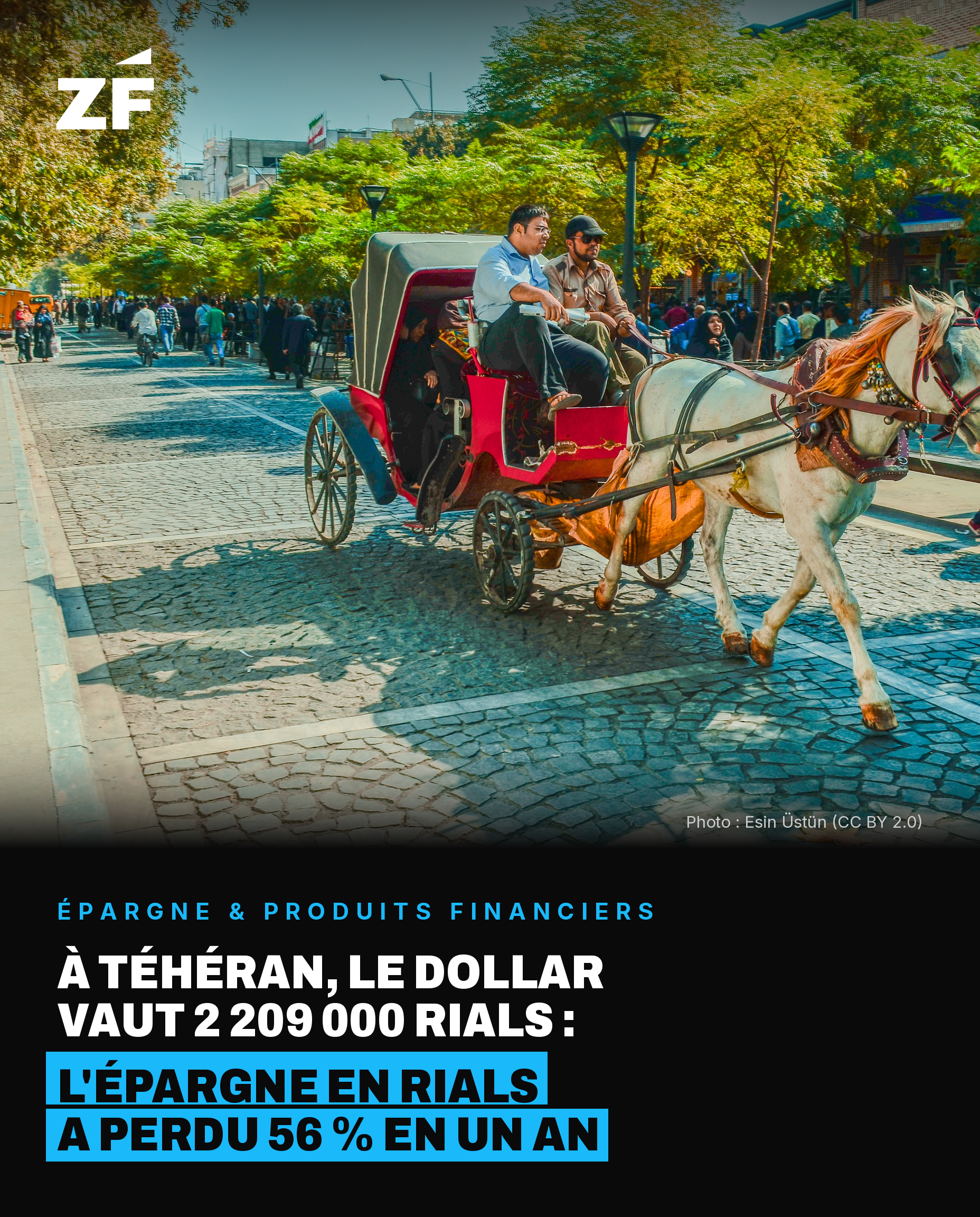
#SAVINGS & FINANCIAL PRODUCTS
The dollar trades at 2,209,000 rials on Tehran's free market. The figure reads like geopolitical news; it is first a levy on Iranian savings. Over twelve months the dollar went from a low of 974,500 rials to a high of 2,218,000.
Published on September 3, 2026 · Figure due for an update since October 3, 2026
Two independent trackers of Iran's free market give the same order of magnitude: 2,209,000 rials per dollar at AlanChand on 3 September 2026, 2,223,000 rials at Bonbast at the close of 2 September. Over the past 365 days AlanChand records a low of 974,500 rials and a high of 2,218,000: between those two bounds the rial lost 56% of its value against the dollar. The move is accelerating — the dollar is up 8.98% in a week and 32.75% over six months.
What does a collapsing currency cost the person who saves in it?
Between the low and the high of the past twelve months, savings held in rials lost 56% of their dollar value — no tax, no fee, no line on any statement.
In other words: a devaluation is not world news, it is a levy on whoever holds the currency.
Five caveats, because they matter
- There is no single rate but several: Tehran cash, remittance, Istanbul, Sulaymaniyah, Herat, each quoted separately — leaving aside the central bank's official rate. The figure here is Tehran cash.
- The two trackers do not give exactly the same number (2,209,000 against 2,223,000): a free-market rate is an average of exchange offices, not an official quote.
- The twelve-month low and high are not necessarily the first and last day of the period: the 56% measures a range, not a date-to-date change.
- An exchange rate is not a domestic price level. What an Iranian household loses in local purchasing power depends on Iranian inflation, which follows the devaluation without matching it.
- In Iran prices are counted in tomans: one toman is ten rials. The "2.2 million" of the wire reports is 220,900 tomans in Tehran.
Why it still matters: holding money is never neutral: when it depreciates, the levy is invisible, immediate and uncapped.
For you
- When a currency loses half its value in a year, who pays: the state, the importer, or the person who had saved?
- By what measure do you judge your savings — the number displayed, or what it buys?
Source: AlanChand, Iranian free-market quote, 3 September 2026 (2,209,000 rials per dollar; 365-day low and high: 974,500 and 2,218,000), cross-checked against Bonbast, archive of 2 September 2026 (222,300 tomans, i.e. 2,223,000 rials).
View the source →